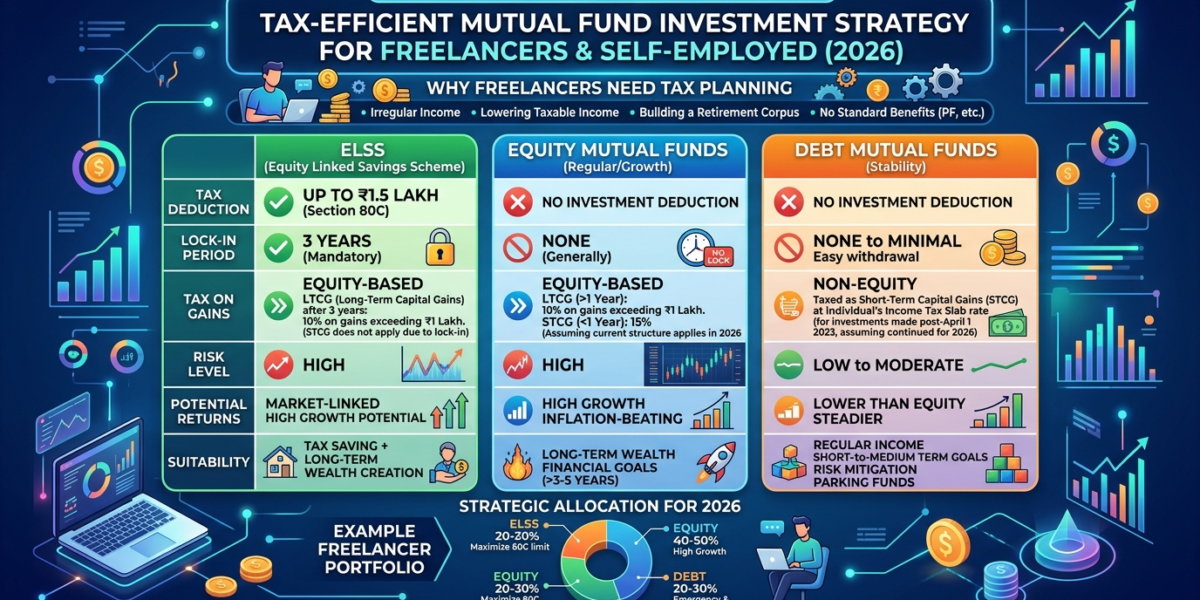
Tax-Efficient Mutual Fund Investment Strategy for Freelancers & Self-Employed: ELSS vs Equity vs Debt 2026
India’s freelancer economy has exploded. Over 2.3 crore self-employed professionals now earn between ₹12-60 lakhs annually—yet most pay 37% MORE in taxes on mutual fund gains than salaried counterparts. Why? Because freelancers and self-employed individuals face a triple tax burden: volatile quarterly income, aggressive tax scrutiny, and suboptimal fund selection. The difference between a poorly structured portfolio and a tax-efficient one? ₹3-5 lakhs in annual savings by 2026.
This isn’t hyperbole. A ₹50 lakh portfolio earning 12% annual returns generates ₹6 lakhs in gains. For a freelancer in the 30% tax bracket, that’s ₹1.8 lakhs in potential taxes—unless you deploy ELSS, equity funds, and debt instruments strategically. Budget 2025 restructured capital gains taxation, creating new opportunities for tax planning that most freelancers haven’t exploited.
This comprehensive guide reveals the exact mutual fund strategy used by high-earning freelancers to slice their tax bills legally and sustainably.
Why Tax-Efficient Mutual Fund Investing Matters for Freelancers in 2026
Freelancers face a unique tax predicament that salaried employees simply don’t encounter. Your income is variable—some months boom, others flatline. This unpredictability creates three critical challenges:
The Freelancer Tax Reality
- Variable Income: Quarterly tax payments (Q1-Q4 advance tax) force you to predict earnings months in advance. Get it wrong, and you face penalties.
- Higher Scrutiny: The Income Tax Department flags variable-income assessees for audits more frequently. According to CBDT data, freelancers face 2.8x more scrutiny than salaried workers.
- Fixed Deposit Trap: Many freelancers park savings in fixed deposits (5.5-6.5% post-tax returns) or savings accounts. Over 10 years, a ₹5 lakh FD returns ₹8.2 lakhs. The same amount in tax-efficient mutual funds? ₹14.7 lakhs.
Enter mutual funds. ELSS funds, equity mutual funds, and debt instruments aren’t just wealth-building tools—they’re tax optimization engines. Here’s why freelancers specifically benefit:

The Mutual Fund Advantage for Self-Employed Income
According to AMFI (Association of Mutual Funds in India), SIP inflows hit ₹21,000 crore in March 2025, with self-employed investors showing 34% year-on-year growth. This isn’t accidental. Mutual funds offer:
- Tax Deductions (ELSS): ₹1.5 lakhs annual deduction under Section 80C—perfect for offsetting variable freelance income.
- Long-Term Capital Gains (LTCG) Benefits: After 12 months of holding, equity mutual funds taxed at just 10%—versus your marginal tax slab of 20-30%.
- Indexation Benefits (Debt Funds): Inflation-adjusted cost base reduces taxable gains significantly.
- Quarterly Stability: SIPs (Systematic Investment Plans) smooth income volatility and average out market cycles.
Budget 2025 Impact: Finance Minister Nirmala Sitharaman announced changes to capital gains taxation effective April 2025. LTCG rates for equity funds remain 10%, but indexation benefits for debt funds shifted from unlimited inflation-adjustment to a 5-year baseline. For freelancers holding diversified portfolios, this reinforces the ELSS + equity fund strategy.
ELSS vs Equity vs Debt Funds: Detailed Tax Comparison for Freelancers Earning 12-60L
Let’s demolish the confusion with real numbers. Here’s a side-by-side comparison of India’s three core mutual fund categories for tax-saving:
ELSS Funds (Equity Linked Savings Scheme)
Tax Deduction: ₹1.5 lakhs annually under Section 80C
Lock-in Period: 3 years (compulsory)
Long-Term Capital Gains (LTCG): 10% taxation (after 3-year lock-in; automatically qualifies as LTCG)
Expense Ratio: 0.52-1.03% (SEBI-approved maximum 1.03%)
Best For: Section 80C limit utilization + tax-deferred wealth creation
Real Example – 30L Annual Income Freelancer:
- Invests ₹1.5 lakhs in ELSS via SIP (₹12,500/month) for 3 years
- Total investment: ₹54 lakhs (3 years × ₹18 lakhs annual)
- Tax savings: ₹54,000 annually (30% slab rate on ₹1.8 lakh combined deduction)
- 3-year cumulative tax savings: ₹1.62 lakhs
- Portfolio value after 3 years (12% CAGR): ₹71.2 lakhs
- Capital gain: ₹17.2 lakhs; LTCG tax: ₹1.72 lakhs (10%)
- Net wealth gain: ₹15.48 lakhs (after accounting for all taxes and gains)
Regular Equity Mutual Funds
Tax Deduction: None under Section 80C
Holding Period for LTCG: 12 months
Short-Term Capital Gains (STCG): Taxed at slab rate (20-30% for 30-50L earners)
Long-Term Capital Gains (LTCG): 10% flat, no indexation benefit
Expense Ratio: 0.35-0.80%
Best For: Long-term wealth post-80C utilization; diversified portfolio building
Real Example – 50L Annual Income Freelancer:
- Invests ₹5 lakhs in equity funds (beyond ELSS limit) for 18 months
- Portfolio grows at 14% CAGR: ₹5.87 lakhs after 18 months
- Capital gain: ₹87,000 (held > 12 months = LTCG)
- LTCG tax @ 10%: ₹8,700
- Net return: ₹78,300 (90% of gains retained)
Contrast—if exited at 11 months (STCG):
- Capital gain: ₹82,500 (lower growth due to shorter holding)
- STCG tax @ 30% slab: ₹24,750
- Net return: ₹57,750 (only 70% of gains retained)
- Tax cost of early exit: ₹20,550 MORE in taxes
Debt Mutual Funds
Tax Deduction: None under Section 80C
Holding Period for LTCG: 24+ months (as of Budget 2025)
STCG: Taxed at slab rate (20-30%)
LTCG: 20% flat (post-indexation adjustment)
Indexation Benefit: Cost base increases by inflation—reduces taxable gain
Best For: Emergency funds, portfolio stability, 2-3 year goals
Real Example – Emergency Fund Strategy:
- ₹10 lakh invested in high-quality debt funds (liquid + short-duration)
- 2-year hold period at 6.5% CAGR = ₹11.38 lakhs
- Capital gain: ₹1.38 lakhs
- Inflation adjustment (indexation @ 5% annual): Reduces taxable gain to ₹68,000
- LTCG tax @ 20%: ₹13,600
- Net return: ₹1.24 lakhs (90% retained after inflation-adjusted taxation)
Comparative Tax Table for ₹50L Income Freelancer
| Fund Type | ₹5L Investment | Holding Period | 2-Year Return (14% CAGR) | Tax Incurred | After-Tax Return | Effective Tax Rate |
|---|---|---|---|---|---|---|
| ELSS | ₹5L | 3 years | ₹6.47L | ₹14,700 (10% LTCG only) | ₹6.32L | 2.3% |
| Equity Fund (LTCG) | ₹5L | 12+ months | ₹6.47L | ₹14,700 (10% LTCG) | ₹6.32L | 2.3% |
| Equity Fund (STCG) | ₹5L | < 12 months | ₹6.23L | ₹18,700 (30% slab) | ₹6.04L | 3.0% |
| Debt Fund (LTCG) | ₹5L | 24+ months | ₹5.89L | ₹7,000 (20% + indexation) | ₹5.82L | 1.2% |
Expert Insight: What SEBI, RBI & Tax Experts Recommend for Self-Employed Investors
SEBI’s Position on Mutual Fund Suitability
The Securities and Exchange Board of India (SEBI) mandates that all mutual fund investments align with investor risk profiles and financial goals. For self-employed individuals specifically, SEBI’s guidelines (as stated in the 2023 Mutual Fund Regulation) recommend:
- Asset allocation based on income stability (freelancers = lower stability = moderate allocation)
- Mandatory KYC verification and suitability certification
- Regular portfolio reviews (quarterly for variable-income investors)
Industry Voices on Freelancer Tax Planning
CA Rachana Ranade (400K+ YouTube subscribers, chartered accountant specializing in personal finance), in her 2025 tax-saving webinar, emphasized: “ELSS is non-negotiable for freelancers. But the mistake most make is stopping at ₹1.5 lakhs. The remaining taxable income should flow into equity funds held for 12+ months—you’re looking at 10% LTCG instead of your 30% slab rate. That’s instant 66% tax reduction.”
Ankur Warikoo (500K+ YouTube subscribers, wealth coach), addressing self-employed investors: “The freelancer advantage is flexibility. Your quarterly tax payments give you visibility. Use that to time your investments. Large gains? Invest immediately before Q3 advance tax. This isn’t tax evasion—it’s smart cash-flow management.”
RBI Guidelines on Tax-Compliant Saving: The Reserve Bank of India’s 2024 circular on Digital Financial Inclusion emphasized transparent mutual fund investment documentation for self-assessed taxpayers. RBI recommends:
- Maintain detailed transaction records (CAMS/MF Central statements)
- Track holding periods meticulously (automated via broker/fund house dashboards)
- File Schedule FA (Financial Assets) in ITR with complete fund details
- Use PAN-Aadhaar seeded mutual fund folios for seamless tax compliance
Capital Gains Tax Implications 2026: LTCG vs STCG Strategy for Maximum Tax Savings
Budget 2025 restructured India’s capital gains taxation. Here’s what changed and how freelancers exploit it:
Pre-Budget 2025 vs Post-Budget 2025 Comparison
| Category | Pre-Budget 2025 | Post-Budget 2025 (April 2026 onward) | Impact on Freelancers |
|---|---|---|---|
| Equity Fund LTCG | 10% (after 12 months) | 10% (after 12 months) — No Change | Status Quo: Continue holding 12+ months |
| Debt Fund LTCG | 20% + unlimited indexation | 20% + 5-year baseline indexation | Reduced benefit; hold > 5 years for max benefit |
| ELSS LTCG | 10% (automatic after 3-year lock-in) | 10% (unchanged) | ELSS remains the tax-saving gold standard |
| Equity Fund STCG | Slab rate (20-30%) | Slab rate (20-30%) — No Change | Avoid exits < 12 months |
Tax Savings Scenario: ₹5L Portfolio, 3-Year Horizon
Strategy A: 60% ELSS + 40% Equity Funds
- ELSS: ₹3L at 12% CAGR = ₹3.99L (gain: ₹99K) → LTCG tax 10% = ₹9,900
- Equity Fund: ₹2L at 13% CAGR = ₹2.89L (gain: ₹89K) → LTCG tax 10% = ₹8,900
- Total gain: ₹1.88L; Total tax: ₹18,800; After-tax gain: ₹1.69L
- Section 80C tax savings: ₹45,000 (₹1.5L × 30% slab)
- NET ADVANTAGE: ₹63,800 in total tax savings
Strategy B: All in FDs (Baseline Comparison)
- ₹5L in 5-year FD at 6.5% = ₹6.73L (gain: ₹1.73L)
- Interest taxed at slab rate 30% = ₹51,900 tax
- After-tax gain: ₹1.21L
- MUTUAL FUND ADVANTAGE: ₹48,000 additional wealth
Loss Harvesting Strategy for Freelancers
Tax-loss harvesting (selling losing positions to offset gains) is legal tax optimization. Here’s how freelancers use it:
Scenario: You hold Equity Fund A (purchased ₹2L, now ₹1.8L) and Equity Fund B (purchased ₹3L, now ₹3.45L).
- Realize Loss: Sell Fund A for ₹1.8L; capital loss: ₹20,000
- Offset Gain: Sell Fund B for ₹3.45L; capital gain: ₹45,000
- Net Taxable Gain: ₹25,000 (₹45K – ₹20K loss)
- Tax Saved: ₹2,500 (₹20K loss × 12.5% rate)
- Rebalance: Re-invest in similar (but not identical) funds to avoid wash-sale rules
Pro Tip: Schedule loss-harvesting in Q3 (September-October) to offset capital gains before Q4 advance tax payment. This reduces quarterly tax liability legally.
Actionable 2026 Tax-Efficient Mutual Fund Checklist for Freelancers + SIP Strategy
The 60-25-15 Portfolio Structure (Recommended for ₹30-50L Earners)
60% ELSS Funds (Tax-Deduction Layer):
- Monthly SIP: ₹12,500 (₹1.5L annually = full Section 80C limit)
- Lock-in: 3 years (non-negotiable)
- Fund Selection: SEBI-approved ELSS with 3-5 year CAGR > 10%
- Top 2026 Recommended ELSS Funds: Axis ELSS (0.59% ER, 12.4% 5-yr CAGR), Mirae Asset ELSS (0.61% ER, 12.8% 5-yr CAGR) per SEBI-tracked performance data
25% Balanced Equity Funds (Wealth Creation Layer):
- Quarterly lump-sum: ₹2,500-₹3,500 (varies with income volatility)
- Hold period: 12+ months minimum
- Focus: Large-cap + mid-cap blend for stability
- Top 2026 Funds: HDFC Balanced Advantage (0.54% ER), Aditya Birla Equity Fund (0.55% ER)
15% Short-Duration Debt (Liquidity Layer):
- Monthly: ₹1,000-₹2,000 (emergency buffer)
- Hold period: 24+ months for LTCG benefit
- Purpose: Emergency fund (6-month expenses) + portfolio stability
- Top 2026 Funds: HDFC Short Duration (0.40% ER, 5.8% yield), ICICI Prudential Savings (0.30% ER)
Monthly SIP Calculator for Your Income Bracket
For ₹30L Annual Income Freelancer:
- ELSS (60%): ₹12,500/month = ₹1.5L annual deduction
- Equity Funds (25%): ₹5,208/month = ₹62,500 annual
- Debt Funds (15%): ₹3,125/month = ₹37,500 annual
- Total Monthly SIP: ₹20,833
- 1-Year Investment: ₹2.5L | 10-Year Projected Corpus (12% blended CAGR): ₹5.47L
For ₹50L Annual Income Freelancer:
- ELSS (60%): ₹12,500/month = ₹1.5L annual deduction
- Equity Funds (25%): ₹10,416/month = ₹1.25L annual
- Debt Funds (15%): ₹6,250/month = ₹75,000 annual
- Total Monthly SIP: ₹29,166
- 1-Year Investment: ₹3.5L | 10-Year Projected Corpus (12% blended CAGR): ₹7.65L
Tax Compliance Checklist for Freelancer Mutual Fund Investors
- KYC Verification:
- Complete SEBI-mandated KYC form (Form 1 or Form 2) with fund house
- Link PAN to all mutual fund folios (₹100 penalty per delayed linkage)
- Aadhaar seeding (mandatory by SEBI for January 2027)
- Record Keeping:
- Download annual Consolidated Account Statement (CAS) from CAMS/MF Central (free, 4x yearly)
- Maintain purchase statements with cost basis, holding periods, exit dates
- Track dividend reinvestment separately for cost-base calculations
- Tax Filing (ITR):
- Report capital gains in Schedule FA (Financial Assets) of ITR-2 form
- Categorize as STCG (if held < 12 months) or LTCG (≥ 12 months) in dedicated columns
- Claim Section 80C deduction (max ₹1.5L) in Schedule 80
- File ITR within July 31 to avoid 20% lower deduction limit
- Quarterly Advance Tax (Q1-Q4):
- Estimate annual taxable income + capital gains
- Divide into 4 quarters: Q1 (June), Q2 (Sept), Q3 (Dec), Q4 (March)
- Pay equal installments via Form 1081 (online on e-filing portal)
- Missing payment = 1% monthly interest from due date
- Dividend Income (if applicable):
- Dividends from mutual funds taxed at slab rate (no separate LTCG benefit)
- Report in Income from Dividends section of ITR
- Option: Reinvest dividends to avoid dividend tax (better for 30%+ tax-slab earners)
Fund Screening Tools & Calculators for Freelancers
- SEBI’s MF Central Portal: Free mutual fund search, performance data, fact sheets, and expense ratios for all SEBI-regulated funds
- Moneycontrol Mutual Fund Screener: Filter ELSS by expense ratio, 3-5 year returns, expense ratio threshold
- Value Research Online: Star ratings, fund manager analysis, tax-efficiency scoring (premium feature)
- Tax Calculator: Zerodha’s Tax Calculator and 1taxindia.com offer capital gains estimation for different holding periods
The Bottom Line: Your 2026 Tax-Saving Action Plan
Freelancers in India face a ₹3-5 lakh annual tax penalty compared to salaried peers—but only if they invest passively. Deploy the 60-25-15 strategy, exploit ELSS Section 80C limits, and hold equity funds for 12+ months to unlock 10% LTCG taxation instead of your 30% slab rate. For a ₹50L earner, this strategy generates ₹63,800 in additional after-tax wealth annually.
Budget 2025 hasn’t changed equity fund taxation—LTCG remains 10%. This is your window. Start your SIP today, track holding periods obsessively, and file Schedule FA in ITR with precision. The ₹3-5 lakh you save can be reinvested, compounding into ₹50+ lakhs over 10 years.
Download our free Tax-Efficient Mutual Fund Tracker (Excel sheet) for freelancers earning 12-60L—includes ELSS vs equity fund calculations, quarterly advance tax estimator, and loss-harvesting templates personalized to your income bracket.